RSS

The Safety Net: What Are You Contributing?

I have seen the “safety net” today and it is in trouble as every funding source shrinks the money provided for projects and operations. And you could do something about it by volunteering your time and knowledge to help a not for profit survive, especially a social service provider to the neediest.

In 2007, Harvard Community Partners of CT created a pro bono workshop for leaders of not for profits in Connecticut. In our state as in your neighborhood, an army of dedicated and experienced professionals without management training lead organizations that help teens recover from their mistakes, light up mentally challenged children with participative music and art, comfort and support the elderly and lots more. Today, three dozen or so such leaders were treated to an interactive workshop on “execution:” getting things done with smart planning and action. They analyzed a past project for its deficiencies, then planned the most critical next project. As evidenced by their comments in the wrap-up on what they learned, the Harvard Business School Alumni who facilitated made a difference that will be amplified by the leaders on return to their organizations.

And you…what can you do beside write a check? Identify a not for profit that needs help and volunteer. Check in with your own alumni organization or religious institution for opportunities to volunteer.

What’s in it for you? Personal satisfaction. The reward of seeing good people succeed. And learning. Yes, learning. One of my friends volunteered for a very difficult challenge faced by a local charity. Soon he was a volunteer project leader. Then the Chairman of the charity. Always a financial functional person in his jobs, he learned what it is like to sit in the hotseat. Then he was recruited away from his CFO job to be president and heir-apparent apprentice to the CEO of a small business. It could happen to you.

That’s my view. What’s yours?

Harvard Community Partners CT

Tags: , , , , ,

Leave a Reply

You need to a flashplayer enabled browser to view this YouTube video

You need to a flashplayer enabled browser to view this YouTube video

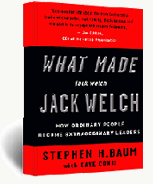
What Made jack welch JACK WELCH

How Ordinary People Become
Extraordinary Leaders

by Stephen H. Baum (Random House)

Most leaders of American companies started out as ordinary people. What prepared them for the top job?

Countless more ordinary people of equal talent never developed the leadership core required to run the show. Why not?

"Lessons for life about the core leadership traits of character, risk taking decisiveness and the ability to engage and inspire followers."
--Jim Clifton, CEO, The Gallup Organization

Read More >>

Buy Now
Amazon
Barnes & Noble
Booksense

Asides
  • Is our behavior in the face of challenge determined at birth or by our environment? Are leaders born rather than made?

    My obsession with what makes some ordinary people become extraordinary leaders led to my interviews with dozens of CEOs which Random House published in 2007 and to the Master Class series at Pace. The thesis is that there are particular “shaping experiences” which develop leadership traits and capabilities.

    Epi-genetics is the new field of study that is beginning to confirm that nurture determines a lot about us: our behavior, our illnesses and more. Work on animals and on human twins shows that no matter your genome, there is a system of markers that switch genes on and off in a way that controls your reaction to stimuli. These markers are largely from environmental factors from what happened while you were in the womb, to how you were treated in your childhood, to stressful situations to pollution. And the markers you have accumulated can go-awry as you age.

    The good news is that by treatment, including drugs, these markers can be added or removed.

    Together with breakthroughs in neuroscience (how our brain works during different mental and emotional conditions), we are about to glean powerful new understandings relevant to our lives as well as careers.

    For an intro to the field, view the PBS Nova Science Now program on the subject:

    http://www.pbs.org/wgbh/nova/sciencenow/3411/02.html

    That’s my view. What’s yours?

  • For a few years now, Jim Blasingame and I have shared stories, insights and practical suggestions for survival of small business in tough times. He should be your fave for an unlimited supply of helpful ideas for your business. Go to:

    http://blog.smallbusinessadvocate.com/management-fundamentals/small-business-economic-challenges
    and also to the home page of smallbusinessadvocate.com

    Please let me know how helpful you find this great resource. Jim is, himself, a very successful small business owner who knows whereof he speaks.

  • As I said in a prior post, the fruit vendor on a nearby street corner in New York City told me he is working on becoming a bank holding company so he can get in line for a bailout. Is there no end?

    Today’s announcement it was announced that insurance companies will be allowed to reduce the reserve capital they have to make sure they can pay benefits to customers when the time comes. Isn’t this converting insurers to be like AIG? Isn’t insurance with low reserves the same as gambling?

    There was no accompanying clear and detailed plan for oversight. Just like the billions of dollars that have flowed into the investment bank.

    That’s my view. What’s yours?