RSS

We’re Back! And the Outlook Hasn’t Changed.

We took a hiatus from the blogosphere, but we are back. There is simply too much that demands comment and too much to share from our frequent conversations with business owners and CEOs.

It is still not clear to my community that the stimulus package will stimulate any time soon. After our monthly group meeting this week, I will report our members’ current time horizon for recovery. However, for now most of the for-profits are still reducing capacity (more than just cutting costs), continuing outsourcing, yet capitalizing on opportunities to acquire key talent (individually or an earn-out of a distressed company).

And most have also taken a page from Obama — grace and calm under duress. One of the biggest challenges has been to help managers and employees understand the tough choices being made without instilling panic. This has required frequent communication, making the CEO’s thinking visible and conducting a real education effort about how the cash flow and P&L work when demand drops.

Most of the CEOs in our peer advisory group are far better connected (with bankers, economists, other CEOs) than those within the company). The education effort includes compelling stories and insights from such contacts.

That’s my view. What’s yours?

Tags: , , ,

Leave a Reply

You need to a flashplayer enabled browser to view this YouTube video

You need to a flashplayer enabled browser to view this YouTube video

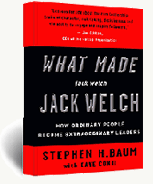
What Made jack welch JACK WELCH

How Ordinary People Become
Extraordinary Leaders

by Stephen H. Baum (Random House)

Most leaders of American companies started out as ordinary people. What prepared them for the top job?

Countless more ordinary people of equal talent never developed the leadership core required to run the show. Why not?

"Lessons for life about the core leadership traits of character, risk taking decisiveness and the ability to engage and inspire followers."
--Jim Clifton, CEO, The Gallup Organization

Read More >>

Buy Now
Amazon
Barnes & Noble
Booksense

Asides
  • Is our behavior in the face of challenge determined at birth or by our environment? Are leaders born rather than made?

    My obsession with what makes some ordinary people become extraordinary leaders led to my interviews with dozens of CEOs which Random House published in 2007 and to the Master Class series at Pace. The thesis is that there are particular “shaping experiences” which develop leadership traits and capabilities.

    Epi-genetics is the new field of study that is beginning to confirm that nurture determines a lot about us: our behavior, our illnesses and more. Work on animals and on human twins shows that no matter your genome, there is a system of markers that switch genes on and off in a way that controls your reaction to stimuli. These markers are largely from environmental factors from what happened while you were in the womb, to how you were treated in your childhood, to stressful situations to pollution. And the markers you have accumulated can go-awry as you age.

    The good news is that by treatment, including drugs, these markers can be added or removed.

    Together with breakthroughs in neuroscience (how our brain works during different mental and emotional conditions), we are about to glean powerful new understandings relevant to our lives as well as careers.

    For an intro to the field, view the PBS Nova Science Now program on the subject:

    http://www.pbs.org/wgbh/nova/sciencenow/3411/02.html

    That’s my view. What’s yours?

  • For a few years now, Jim Blasingame and I have shared stories, insights and practical suggestions for survival of small business in tough times. He should be your fave for an unlimited supply of helpful ideas for your business. Go to:

    http://blog.smallbusinessadvocate.com/management-fundamentals/small-business-economic-challenges
    and also to the home page of smallbusinessadvocate.com

    Please let me know how helpful you find this great resource. Jim is, himself, a very successful small business owner who knows whereof he speaks.

  • As I said in a prior post, the fruit vendor on a nearby street corner in New York City told me he is working on becoming a bank holding company so he can get in line for a bailout. Is there no end?

    Today’s announcement it was announced that insurance companies will be allowed to reduce the reserve capital they have to make sure they can pay benefits to customers when the time comes. Isn’t this converting insurers to be like AIG? Isn’t insurance with low reserves the same as gambling?

    There was no accompanying clear and detailed plan for oversight. Just like the billions of dollars that have flowed into the investment bank.

    That’s my view. What’s yours?