RSS

Fund-Raising Right Now

Successful fund-raising in this awful time requires re-thinking some basics.

Yesterday, I emceed a workshop of 35 Executive Directors and Board chairs of not for profits as part of the pro bono activities of Harvard Community Partners of CT. The topic was Mission Statement: Tying Mission to Performance. Pairs (an E.D. and a Board member) from one organization put away their written statements and articulated from mind and heart their mission statement to a “murder board” of two other pairs from different organizations in a structured, facilitated process.

In other years, this workshop has been highly valued for its compact learning on a topic that was important but not urgent.

This year, there was a 1-ton gorilla in the room that was distracting the participants: the precipitous loss of wealth since early October, the outlook for a worsening economy and the need to continue fund-raising during this perfect storm.

As one of the participants observed in the wrap-up, this used to be viewed as part of the often-spoofed “vision thing.” Now it is the heart of fund-raising. If you cannot recite the five or six bullets of your mission statement, if you cannot articulate in powerful and memorable words the crucial social value you create as a not for profit and dire consequences for the afflicted whom you serve, forget fund-raising.

If, however, you have replaced the politically negotiated generality-ridden platitudes with tangible descriptions of the difference you make and (passionately) why your organization is more worthy than others, you will win a larger share of the philanthropy. You will be able to do it on the fly as well as in scheduled meetings.

More than a few of these leaders revamped their mission statements in this way and committed to return to their organizations to put their colleagues through a similar process.

That’s my view. What’s yours?

Tags: , , , ,

Leave a Reply

You need to a flashplayer enabled browser to view this YouTube video

You need to a flashplayer enabled browser to view this YouTube video

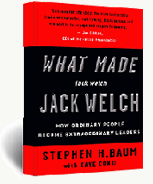
What Made jack welch JACK WELCH

How Ordinary People Become
Extraordinary Leaders

by Stephen H. Baum (Random House)

Most leaders of American companies started out as ordinary people. What prepared them for the top job?

Countless more ordinary people of equal talent never developed the leadership core required to run the show. Why not?

"Lessons for life about the core leadership traits of character, risk taking decisiveness and the ability to engage and inspire followers."
--Jim Clifton, CEO, The Gallup Organization

Read More >>

Buy Now
Amazon
Barnes & Noble
Booksense

Asides
  • Is our behavior in the face of challenge determined at birth or by our environment? Are leaders born rather than made?

    My obsession with what makes some ordinary people become extraordinary leaders led to my interviews with dozens of CEOs which Random House published in 2007 and to the Master Class series at Pace. The thesis is that there are particular “shaping experiences” which develop leadership traits and capabilities.

    Epi-genetics is the new field of study that is beginning to confirm that nurture determines a lot about us: our behavior, our illnesses and more. Work on animals and on human twins shows that no matter your genome, there is a system of markers that switch genes on and off in a way that controls your reaction to stimuli. These markers are largely from environmental factors from what happened while you were in the womb, to how you were treated in your childhood, to stressful situations to pollution. And the markers you have accumulated can go-awry as you age.

    The good news is that by treatment, including drugs, these markers can be added or removed.

    Together with breakthroughs in neuroscience (how our brain works during different mental and emotional conditions), we are about to glean powerful new understandings relevant to our lives as well as careers.

    For an intro to the field, view the PBS Nova Science Now program on the subject:

    http://www.pbs.org/wgbh/nova/sciencenow/3411/02.html

    That’s my view. What’s yours?

  • For a few years now, Jim Blasingame and I have shared stories, insights and practical suggestions for survival of small business in tough times. He should be your fave for an unlimited supply of helpful ideas for your business. Go to:

    http://blog.smallbusinessadvocate.com/management-fundamentals/small-business-economic-challenges
    and also to the home page of smallbusinessadvocate.com

    Please let me know how helpful you find this great resource. Jim is, himself, a very successful small business owner who knows whereof he speaks.

  • As I said in a prior post, the fruit vendor on a nearby street corner in New York City told me he is working on becoming a bank holding company so he can get in line for a bailout. Is there no end?

    Today’s announcement it was announced that insurance companies will be allowed to reduce the reserve capital they have to make sure they can pay benefits to customers when the time comes. Isn’t this converting insurers to be like AIG? Isn’t insurance with low reserves the same as gambling?

    There was no accompanying clear and detailed plan for oversight. Just like the billions of dollars that have flowed into the investment bank.

    That’s my view. What’s yours?