RSS

Liberating Yourself From Repeated Emotional “Grabs” (Free tool)

Thu, Jul 17, 2008

Leadership Development

We have previously written about moments when something someone says or does “grabs” us — provokes an emotional response and behavior that is not really in our own interest or helpful toward our agenda. We are in a fight or flight mode instead of staying centered and responding with a more “blending (collaborative)” or detached exchange which might have served us better.  We backed away or came on strong when there were other choices. 

Here is a tool that my chief executives are using to get a handle on this through self-discovery.

Keep a couple of index cards in your shirt or jacket pocket at all times. In advance, write the tabs below on the cards (or print out cards with the tabs already on the cards). The first chance you have when you are alone after someone says or does something that sets you off,  fill in the blanks with at most one or two lines:

-  Who (name of person who grabbed me)

-  Where (location and who else present

-  What (was said or done that grabbed me)

-  What I said or did in response (my behavior)

-  Why (why I was upset ) 

At the end of the day, throw the completed card or cards in a drawer. At the end of a week and after two weeks, take some quiet time when you are calm and read the cards.  

Are there any patterns to the “grabs” in your answers to 1 through 5?  Did some grabs stay with you for more than a day?  Were there consequences for your responses that you don’t like, either in business results or relationships or your own emotional state? What are they? Write up a summary of your analysis  (one page, headline style). 

Now examine the summary and dig into your “mind map:” what long-standing, deeply-held assumptions or beliefs were threatened? What “fear” or “no fly zone” was inflamed?  Did you feel your integrity was impugned? that your worth was challenged?  your intelligence questioned and you felt you would appear stupid? Can you identify moments long ago when you first had these feelings? How much of what you felt was driven by your own assumptions and beliefs? 

With the learning that comes from this exercise, you should be able to begin to get “early warning” of grabs, take a breath and classify the grab and treat the incoming with more detachment. If you do, it will save you time and energy and emotional distress not only in the moment, but in cleaning up the aftermath that letting grabs control us often create.  

If you have a story to tell after you try this tool, share it with us.

Tags:

Leave a Reply

You need to a flashplayer enabled browser to view this YouTube video

You need to a flashplayer enabled browser to view this YouTube video

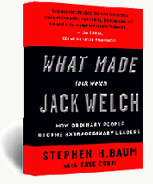
What Made jack welch JACK WELCH

How Ordinary People Become
Extraordinary Leaders

by Stephen H. Baum (Random House)

Most leaders of American companies started out as ordinary people. What prepared them for the top job?

Countless more ordinary people of equal talent never developed the leadership core required to run the show. Why not?

"Lessons for life about the core leadership traits of character, risk taking decisiveness and the ability to engage and inspire followers."
--Jim Clifton, CEO, The Gallup Organization

Read More >>

Buy Now
Amazon
Barnes & Noble
Booksense

Asides
  • Is our behavior in the face of challenge determined at birth or by our environment? Are leaders born rather than made?

    My obsession with what makes some ordinary people become extraordinary leaders led to my interviews with dozens of CEOs which Random House published in 2007 and to the Master Class series at Pace. The thesis is that there are particular “shaping experiences” which develop leadership traits and capabilities.

    Epi-genetics is the new field of study that is beginning to confirm that nurture determines a lot about us: our behavior, our illnesses and more. Work on animals and on human twins shows that no matter your genome, there is a system of markers that switch genes on and off in a way that controls your reaction to stimuli. These markers are largely from environmental factors from what happened while you were in the womb, to how you were treated in your childhood, to stressful situations to pollution. And the markers you have accumulated can go-awry as you age.

    The good news is that by treatment, including drugs, these markers can be added or removed.

    Together with breakthroughs in neuroscience (how our brain works during different mental and emotional conditions), we are about to glean powerful new understandings relevant to our lives as well as careers.

    For an intro to the field, view the PBS Nova Science Now program on the subject:

    http://www.pbs.org/wgbh/nova/sciencenow/3411/02.html

    That’s my view. What’s yours?

  • For a few years now, Jim Blasingame and I have shared stories, insights and practical suggestions for survival of small business in tough times. He should be your fave for an unlimited supply of helpful ideas for your business. Go to:

    http://blog.smallbusinessadvocate.com/management-fundamentals/small-business-economic-challenges
    and also to the home page of smallbusinessadvocate.com

    Please let me know how helpful you find this great resource. Jim is, himself, a very successful small business owner who knows whereof he speaks.

  • As I said in a prior post, the fruit vendor on a nearby street corner in New York City told me he is working on becoming a bank holding company so he can get in line for a bailout. Is there no end?

    Today’s announcement it was announced that insurance companies will be allowed to reduce the reserve capital they have to make sure they can pay benefits to customers when the time comes. Isn’t this converting insurers to be like AIG? Isn’t insurance with low reserves the same as gambling?

    There was no accompanying clear and detailed plan for oversight. Just like the billions of dollars that have flowed into the investment bank.

    That’s my view. What’s yours?